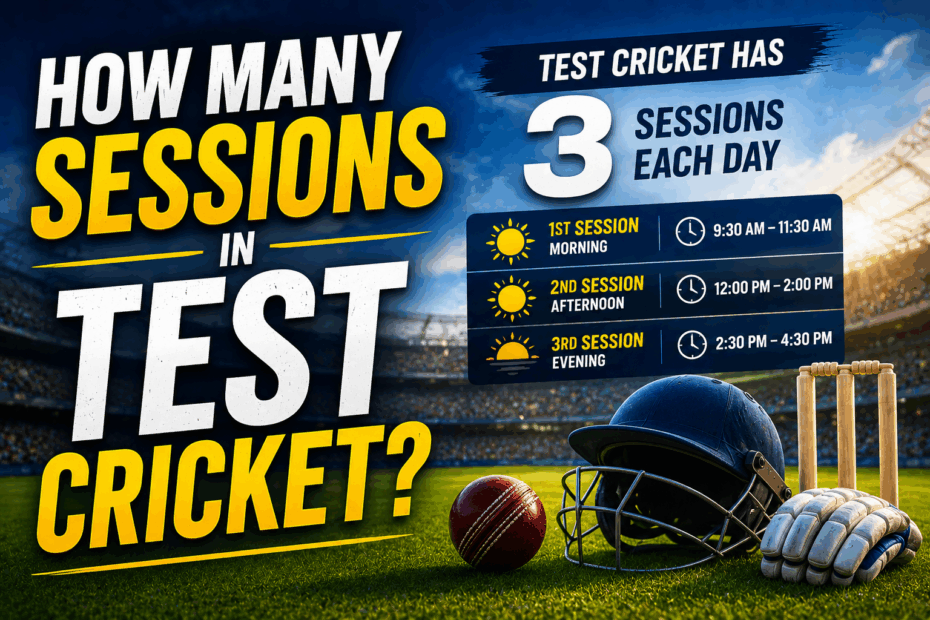
Test cricket is widely regarded as the ultimate test of skill, patience, and endurance, where both teams get two innings each to play. It is a 90-over-per-day format, which can last up to five days. With each day having three sessions – morning, afternoon, and evening with a fixed lunch and tea break. When the Test match runs its full course, it has maximum of 15 sessions in 5 days.
What Happens in Each Session?
Each session is tough competition between batting and bowling side. With batting team aiming to get a specific number of runs on the board, while bowling team tries restrict them under a specific score and wickets in a session. Captain and coach planning, bowling changes, field settings, creating pressure on opposition with bat and bowl, using conditions as lights change across six hours of play.
First Session
First session is important in the Test match, as it gives batting and bowling team a chance to set the tone for entire day. Bowlers, fielders, and other players are at their peak energy, and bowlers also get some movement from the pitch in the beginning.
Generally, batters try to survive, give themselves time as it is the beginning of the match, while bowlers try to take advantage by taking wickets.
Second Session
This session starts after lunch, usually, during this session the pitch settles and sun is high, making batting easier compared to other two sessions. Batting team can unsettle opponents easily during this session, sometimes even adopting an aggressive Bazball-style approach to dominate the bowlers. While bowling team needs to rotate bowlers wisely. Also, spinners can use different angles in this session to take wickets and restrict batters.
Third Session
This session starts after Tea break, commentators also called it the evening session in Test cricket. Ball started getting old during this season, and bowlers start getting reverse swing, spin, and fading light also makes it tough for batters to keep their wickets.
Session Timings in Test Cricket
In a traditional day in Test, play is scheduled for six hours, followed by three sessions of two hours each. If we take an example of a cricket match in India, Start times vary by venue and country, although many matches begin between 9:30 AM and 11:30 AM local time where first session ends for Lunch.
This lunch break is for 40 minutes, after that, the second session starts around 12:10 PM and ends at 2:10 PM for Tea break, which is for 20 minutes. The third session starts around 2:30 PM and ends at 4:30 PM. You can download Indibet apk on your device to know more about the upcoming Test schedules, players records, WTC ongoing table, and lot more.
How Long Is Each Session?
Generally, each session should consist of 30 overs each, but in Test cricket it doesn’t happen every time. The third session can be extended for 30 to 60 minutes, if the bowling team is unable to complete the 90-over quota in a day.
Apart from this, if any team is in a winning position and the last wicket is there to fall, then umpires can extend the session as well. Umpires and match referees monitor over‑rates closely, and teams can be penalised for continuous slow play. A rule that’s separate from run-chase calculations like the DLS method used mainly in limited-overs cricket.
What Breaks Are Taken Between Sessions?
Two breaks are taken before and after the second session. Lunch break is for 40 minutes, while Tea break is for 20 minutes. If innings end, then teams get 10 minutes time to change and come back to the field.
Nowadays, in pink-ball Test matches, which started during the noon session, having similar structure but they take 20 minutes tea break after first session, and 40 minutes dinner break after second session.
Can the Number of Sessions Change?
No, officially there are only three sessions scheduled in a day of a Test match. In cases of rain or any other reason due to which play stops, then overs can be added to each day’s extended time.
Why Are Test Matches Divided into Sessions?
Test matches are divided into sessions, as it keeps people’s interest in the game. If there were continuous play, then it would be extremely long for viewers and players too, especially with 11 players on each side managing energy across a full day. Dividing a day into sessions also helps broadcasters in content scheduling, advertising, and coverage, making Test cricket more viable.
How Sessions Influence Match Strategy
Teams make strategy keeping each session in mind. For instance, a batting side might aim to lose no more than one wicket in the morning, score heavily after lunch, and then attack aggressively in the evening when bowlers tire, while a bowling side might reverse those priorities depending on pitch and ball conditions.
Following Every Session Live
Modern fans can follow every session ball by ball through broadcast coverage, live scorecards, ball‑tracking graphics, and detailed analysis on websites and apps, which present data like runs scored, wickets taken, and session‑wise momentum graphs, a format now followed passionately across 100+ countries that play the sport. To know more, you can visit Indibet bet platform for Test cricket, stats, players, odds, and lot more.
FAQs
How many sessions are there in a five-day Test match?
In a complete five-day Test match, there are 15 sessions, three sessions in each day.
What happens if rain interrupts a session?
If rain or bad light interrupts a session, umpires suspend play and later attempt to make up lost overs by extending play on that same day, up to a maximum of about one extra hour, provided conditions improve and both teams can safely continue.
Can play continue beyond the scheduled session time?
Yes, if the fielding side has not completed the required number of overs, umpires may keep players on the field for extra time until the recalculated minimum overs for the day are bowled or conditions force a halt.
Do day-night Test matches have the same number of sessions?
Yes, Day-night Test matches have the same number of sessions.
Which session is usually considered the best for batting?
The second session is considered best for batting, although climate conditions matter a lot. For instance, if anyone is batting in overcast conditions in any session, it would be difficult.
