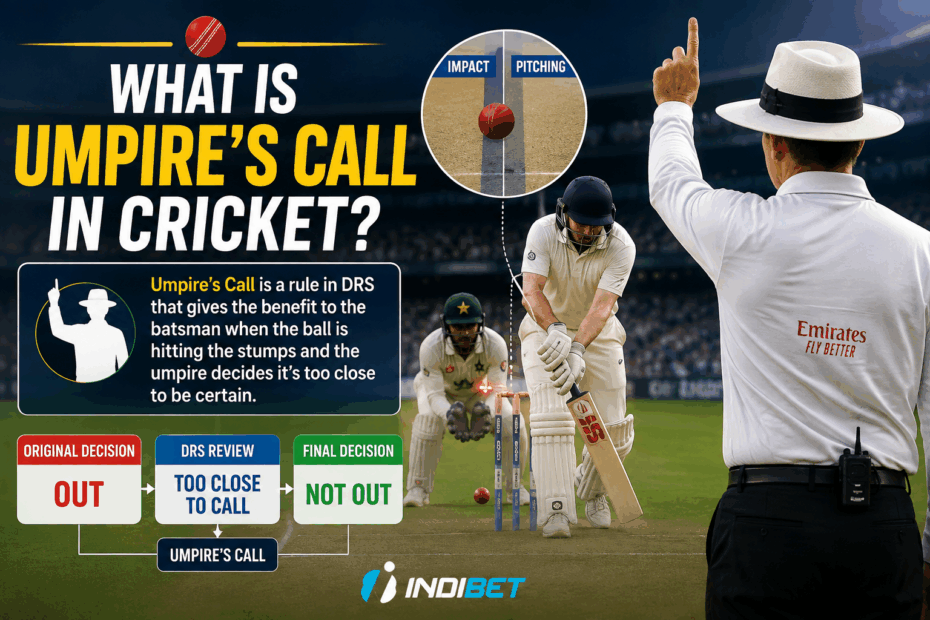
Umpire’s Call is a DRS outcome in marginal LBW reviews where the original on-field decision remains unchanged. With technology like the Decision Review System (DRS), many have seen the term “Umpire’s call” especially in close LBW decisions, where technology shows the ball tracking, predicts impact or contact with the stumps falls within an agreed margin of error.
When Does Umpire’s Call Come Into Play?
Umpire’s Call comes into play when the batting or fielding team reviews an LBW decision using DRS. It Under the current DRS framework, Umpire’s Call applies only to LBW reviews. The third umpire follows the DRS protocol by checking the legality of the delivery, whether the ball made contact with the bat, and the ball-tracking data.
LBW Reviews
In an LBW review, the process starts with the on‑field umpire giving a batter either out or not out, after which the unhappy team has a limited number of player reviews to challenge that call.
Ball Tracking
Ball‑tracking systems such as Hawk‑Eye use multiple camera angles and physics models to reconstruct the ball’s trajectory from bounce to the projected point near the stumps.
Impact and Wicket Zones
For LBW, the ball‑tracking graphics divide the decision into distinct zones:
- Pitching
- Impact
- Wickets
Umpire’s call only applies to the impact and wicket zones. Much like how the DLS method works in cricket to keep rain-affected matches fair, ball-tracking zones add a similar layer of precision and fairness to LBW calls. You can visit the Indibet bet platform to know more details about the cricket rules, stats, players list, upcoming tournaments, and much more.
Why Was the Umpire’s Call Rule Introduced?
The Umpire’s Call rule was introduced by the ICC in 2016 to formalise how DRS should handle. The idea was to encourage umpires to keep making strong on‑field decisions while accepting that both human judgment and technology have limitations, so truly marginal calls would default to the original umpire rather than to the machine.
ICC tried to protect the spirit of fairness and to avoid overturning decisions on the basis of projections that fall within that margin of error. Since cricket today is played competitively across so many countries around the world, the ICC needed a review standard that stayed consistent across every format and venue.
If you enjoy live in‑play markets on platforms like Indibet, understanding this margin becomes crucial because a single umpire’s call can flip an LBW price instantly, even though the graphic shows the ball clipping the stump.
What Happens When the Decision Stays with the On-Field Umpire?
When the result is Umpire’s Call, the original on-field decision remains unchanged.
If the Batter Reviews
If a batter reviews an LBW decision after being given out, and ball‑tracking shows the ball only marginally hitting the stumps so that the result is umpire’s call, the batter remains out, and the original decision stands.
If the Bowling Team Reviews
If the fielding team reviews a not‑out LBW and If ball-tracking produces a marginal result and the outcome is Umpire’s Call, the original not-out decision remains unchanged.
Umpire’s Call vs Out vs Not Out
The final outcome of an LBW review depends on both the original on-field decision and the ball-tracking result. A clear result can overturn the decision, while Umpire’s Call keeps the original decision in place.
| On-field decision | Ball-tracking result | Final decision on field | Review kept? |
| Out | Hitting (clear) | Out | No |
| Out | Missing | Not out | Yes |
| Out | Umpire’s call | Out | Yes |
| Not out | Hitting (clear) | Out | Yes |
| Not out | Missing | Not out | No |
| Not out | Umpire’s call | Not out | Yes |
Does the Team Lose a Review on Umpire’s Call?
No, teams don’t lose a review on umpire’s call, regardless of the decision given by the on-field umpire. This change was introduced after feedback from players, and cricket boards. You can download the Indibet app to know more about the players, teams, DRS, strike rate of batters, live score, odds, stats, and much more.
Famous Matches Where Umpire’s Call Changed the Result
There are many games where the umpire’s call is criticized, especially during the ICC events. Apart from big ICC events, umpire’s calls also come under scrutiny during high-profile test series like the Ashes, Border-Gavaskar Trophy, etc where experts and fans where every one of the 90 overs in a Test match day is watched closely by experts and fans alike. Created social media arguments, debates, and buzz around umpire’s call decisions as well.
Why Umpire’s Call Still Divides Cricket Fans
Umpire’s call splits opinion mainly because two identical deliveries can produce opposite results solely based on what the on‑field umpire said initially, even when the ball‑tracking graphic looks the same.
On the other hand, officials and some former players argue that this system is honest about technology’s margin of error and protects umpires from being undermined by tiny projection differences that fall well within that uncertainty band. You can download the Indibet apk from the platform and enjoy placing bets on different odds, see live scores, blogs, opinions from expert, and much more.
FAQs
Is Umpire’s Call only used for LBW decisions?
Yes, in the current DRS framework, umpire’s call is only used for LBW decisions. Where the batting or bowling side reviews the umpire’s decision and ball tracking is seen. In cases of marginal impact and wicket zone projections on-field umpire decision stays.
Can Umpire’s Call be overturned?
No, on-field umpire decision in umpire’s call can’t be overturned. The only way a call changes is if ball‑tracking shows a clear result.
Why doesn’t technology make the final decision every time?
In clear cases, technology makes the final decision. But the ICC explicitly chose not to rely on ball‑tracking alone for marginal LBWs because every projection involves modelling assumptions and small measurement errors.
Has the ICC ever changed the Umpire’s Call rule?
From 2016 onwards, umpire’s call was formalised for marginal LBWs and teams were later allowed to retain their review when that verdict appeared, a significant change from the early DRS years.
Do players and commentators agree with Umpire’s Call?
Players and commentators are far from unanimous; some defend umpire’s call as a sensible way to balance human judgment and technology, while others feel it confuses fans and undermines the idea that “hitting the stumps means out.”
