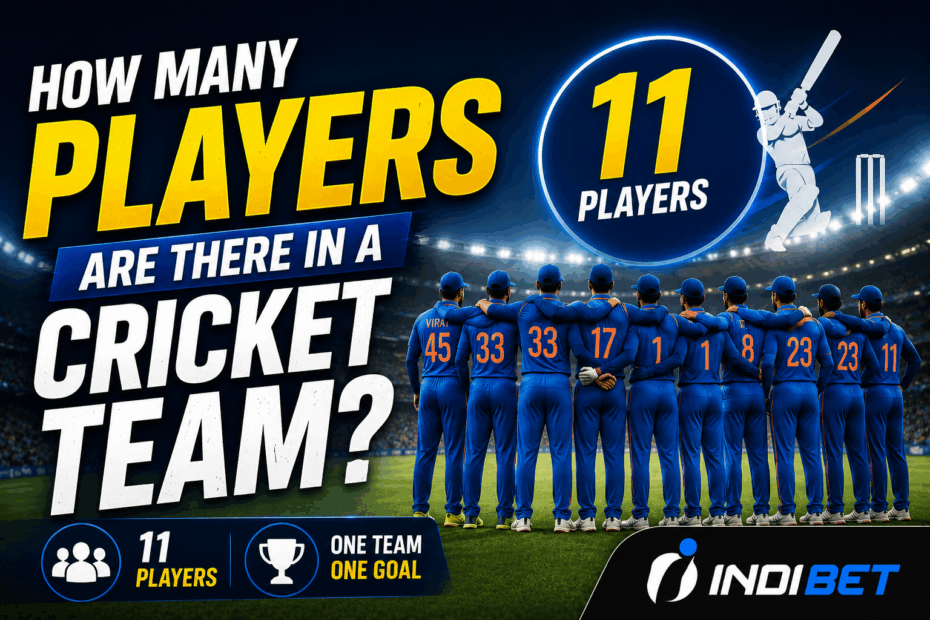
A cricket team has 11 players on each side, who are divided into a wicketkeeper, batters, bowlers, and all-rounders. This is followed in every format: Tests, 50-over ODIs, or T20s. A team may also have additional members, who can act as reserves or substitute players. Let’s understand more about how many players are in a cricket team, and the history behind it.
Why Does a Cricket Team Have 11 Players?
We have seen 11 players in each cricket team. This rule was made by the Marylebone Cricket Club (MCC). Since then, it has been one of the standard laws in cricket and followed in every format. This 11-player team provides balance for batters, bowlers, all-rounders, and wicketkeepers.
The History Behind the Number
Over the years, teams used to follow an 11-player team. The MCC formally declared it. The statement of the law is that each side shall consist of eleven players, one of whom shall be captain.
This rule also ensures that, if all 10 players get out, one batter remains not out. On the pitch, two batters are required, and after getting all 10 players out, only one player is left on the crease, which is counted as not out.
Is It the Same in Every Format?
Yes. The rule of 11 players in a cricket team is followed in every recognized format: Test matches, One Day International ( ODIs), and T20s. While there can be replacements and substitutions, which have different rules, the number of players remains the same.
You may also like to know what retired out in cricket means.
Who Makes Up the Playing XI?
A cricket team of 11 players is a combination of specialist batters, all-rounders, a wicketkeeper, fast bowlers, and spinners to balance batting, bowling, and fielding.
Specialist Batters
The top-order batters are placed initially in the batting order as they are the core of the team’s batting. This helps in making a strong base for a big target.
All-Rounders
All-rounders add flexibility as they can balance both bat and ball, strengthening any of the departments and extending the batting depth.
Wicketkeeper
The wicketkeeper handles catches, stumpings, and byes while batting, to add runs and guide the bowlers. Their batting position depends on the team’s strategy.
Fast Bowlers and Spinners
Fast bowlers use speed, swing, and seam, while spinners rely on control and turns. Both fast bowlers and spinners make it tough for the batters to score.
You may also like our guide on Diamond duck in cricket, which happens rarely in cricket.
What Happens If a Team Has Fewer Than 11 Players?
If a team starts or continues with fewer than 11 players, the match can still proceed, but the side cannot field more than 11 at any time. Injured or ill players may be replaced by a substitute fielder, but under traditional Laws, that substitute cannot bat, bowl, or keep wicket unless specific competition rules allow it.
Injury Replacements
When a player gets hurt or sick during a match, they can have someone field for them, but that person can only field. They cannot bowl. Some teams, like the BCCI and the ECB, have their own rules.
According to the MCC laws, substitute and replacement are different. A substitute player is replaced with a player and can only field. While a replacement becomes a nominated player and can have broader playing rights.
Concussion Substitutes
The International Cricket Council has a rule for when a player gets hurt in the head. This is called the concussion substitute rule. If a player gets a head injury, they can have someone else play for them.
Before the match starts, teams have to say who could be a substitute if someone gets hurt. The person in charge of the match has to agree.
Then the substitute player can bat, bowl, and field only under the specific conditions and approval. The International Cricket Council wants to make sure players are safe.
Impact Player Rule (IPL)
The IPL’s Impact Player rule lets teams name an extra player in their squad who can be substituted in during the match to bat, bowl, or field. The IPL’s rule gives teams an additional tactical replacement option during a match. This rule is specific to the IPL and similar T20 leagues, allowing greater flexibility in team composition compared to traditional international cricket.
If you like to know how NRR is calculated in cricket, you may like our guide. NRR is one of the factors needed to decide which team wins if they have equal scores.
Are There Extra Players in a Cricket Squad?
Yes. There are more than 11 players in a team. More players in a cricket squad work as substitute fielders and reserve players for a series. However, they can’t bat, bowl, or act as a wicketkeeper; they can only do fielding.
Substitute Fielders
If any player in the team’s eleven gets injured or ill, he is replaced by the team’s additional players, who can only act as substitute fielders. The substitute fielder can come only with the umpire’s approval. Once the original player gets fit, he may return to the field.
Reserve Players for a Series
Reserve players travel with the squad but do not feature in the playing XI unless formally promoted due to injury or tactical changes. They support the team in practice (e.g., as net bowlers) and provide depth across formats, especially in long tours or ICC events where squads can expand to 15-22 players.
Does Every Cricket Format Use the Same Team Size?
Yes. Every standard international and domestic cricket format, including Test cricket, ODIs, and T20 matches, uses the exact same team size of 11 players per side on the field.
How Captains Choose the Best Playing XI?
Captains, with the coach, choose the best playing XI, keeping factors in mind like pitch, weather, opponent’s weakness, and players’ recent performances. While the selectors choose the team, the players who actually play in the match are usually picked by the coaching staff just before the toss. This decision often shows what the captain thinks is the way to play the game. You may also like Indibet more guides on cricket topics, where you will find topics like who is the best cricketer in the world, captain of the Indian Cricket team, and much more.
FAQs
Can a cricket match start with only 10 players?
Yes. A cricket match starts with only 10 players if this is agreed under the applicable Laws or competition regulations. However, the standard team size is 11 players per side.
Does the wicketkeeper count as a batter?
Yes. It is one of the players among the 11 cricket players in a team. He is eligible to bat during the team’s innings. The Wicketkeeper’s position in the batting order depends on the team’s strategy.
Can substitute players bat or bowl?
No. Under the ICC/MCC laws, a substitute player can only do fielding; he can’t bat, bowl, keep wicket, or do captaincy. The only common exception is a concussion substitute, who is a like-for-like replacement and can bat, bowl, and field for the rest of the match. In IPL format, a substitute can bat or bowl if there is a tactical change.
Why are cricket teams announced before the toss?
It is done so that the playing XI is known, and any last-minute changes due to injury or fitness can be handled before the match officially begins.
