Cricket is one of the most popular sports in India. It brings excitement and joy to millions of fans. Talented players make every match more entertaining and memorable. But sometimes understanding terms like Net Run Rate (NRR) in cricket can confuse new fans and encourage them to learn more.
In this guide, you’ll learn how Net Run Rate (NRR) is calculated in cricket, understand the formula, and see worked examples from T20 and ODI matches.
Net Run Rate (NRR) is used in cricket to assess a team’s performance. It is also used to rank the teams in the table when they have equal points. NRR is a statistical formula used for fairness and to maintain the game’s competitive balance. Let’s understand how to calculate NRR in cricket.
NRR Formula Explained
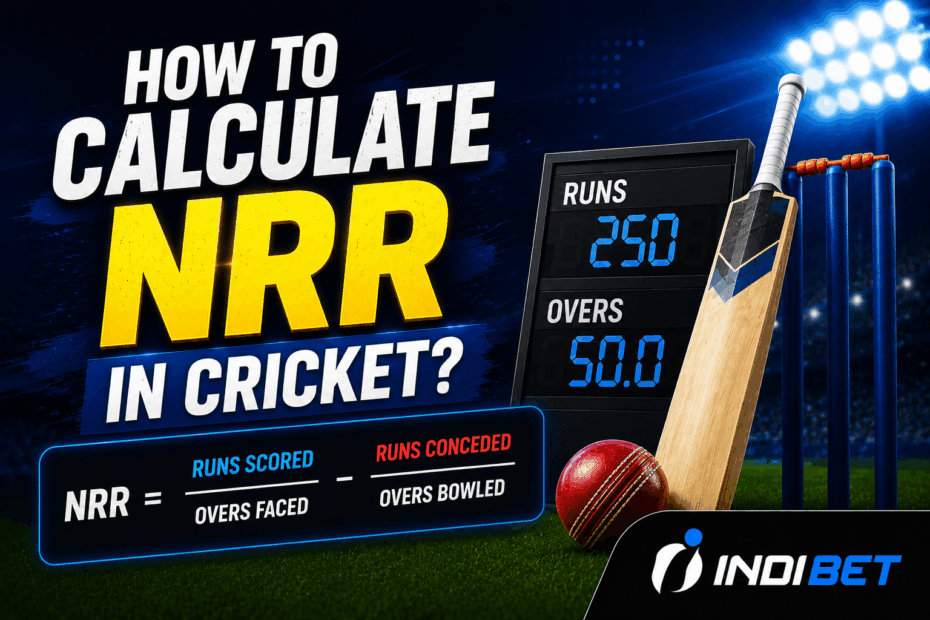
According to ICC playing conditions, Net Run Rate (NRR) is calculated using a team’s scoring rates and conceding rates across matches. To calculate the Net Run Rate (NRR), a statistical formula is used. Four values are needed: total runs scored, total runs conceded, total overs faced, and total overs bowled. Below is the formula mentioned:

Step-by-Step Guide to Calculate Net Run Rate
Follow these steps to calculate NRR.
Calculate Your Team’s Run Rate
A team’s run rate (RR) or runs per over (RPO) is the average number of runs a team scores per over during an innings. For example, Team A made 491 runs in 50 overs; then RR is 491 divided by 50 = 9.82. This is the RR of your team.
Note: If your team made 491 runs in 48 overs and 1 ball, then the total score will be divided by 48.167 ( 48 overs + ⅙).
Calculate the Opponent’s Run Rate
Now, Let’s take Team B, which made 480 runs in 50 overs; then its run rate is 480 ÷ 50 = 9.6. Run rate is calculated by dividing the total runs scored by the total overs faced.
Find the Net Run Rate
Net Run Rate is calculated by using both teams’ run rate. In the above example, Team A wins, and its run rate is more than Team B.
The Net Run Rate for Team A in the above example will be: 9.82 – 9.60, which is +0.22.
The Net Run Rate for Team B in the above example will be: 9.60 – 9.82, which is -0.22.
NRR Calculation with an Example
Let’s take one more example to make it crystal clear.
Single‑match example (T20)
- Your team: 180/4 in 20 overs
- Opposition: 165 all out in 19 overs 5 balls, which is 19.833 overs
Scoring rate = 180 ÷ 20 = 9.000 runs per over
Conceding rate = 165 ÷ 19.833 = 8.318 runs per over
NRR for the match = 9.000 – 8.318 = +0.682
How NRR Is Calculated in Multi-Team Tournaments
When it is a multi-team tournament like the IPL, ODI tournament, or T20 tournament, NRR is calculated by subtracting the team’s average run rate conceded from its average run rate scored. These run rates are calculated using the total runs scored, total runs conceded, total overs faced, and total overs bowled across all completed matches.
For instance, a team’s outcomes in T20 matches are:
- Match 1: scores 170 ÷ 5 in 20 overs, concedes 150 ÷ 7 in 20 overs
- Match 2: scores 160 ÷ 8 in 20 overs, concedes 165 ÷ 6 in 20 overs
- Total runs scored = 170 + 160 = 330
- Total overs faced = 20 + 20 = 40
- Total runs conceded = 150 + 165 = 315
- Total overs bowled = 20 + 20 = 40
- Run rate for = 330 ÷ 40 = 8.250
- Run rate against = 315 ÷ 40 = 7.875
- Overall NRR = 8.250 – 7.875 = +0.375
Note: In Test cricket matches, NRR is not used as it is not a game of limited overs and has a different format to play. Check here how many overs are there in Test Cricket.
What Happens If a Team Is All Out?
When a team is all out or bowled out, the total quota of overs is used for its overs faced. In T20 cricket, the full quota is 20 overs, while in ODIs it is 50 overs.
- Format: T20 (20 overs per side)
- Team A: 140/6 in 20 overs
- Team B: 110 all out in 16 overs 3 balls, which is 16.5 overs
Even though Team B faced only 16.5 overs because they were bowled out, NRR uses the full quota of 20 overs for their batting.
- Team A’s RR is 140/20= 7.00
- Team A’s NRR is = 7.00 – 5.50= + 1.50
- Team B’s RR is 110 ÷ 20 =5.50, Runs Concede = 140 ÷ 20= 7.00
- Team B net run rate is 5.50 – 7.00 = – 1.50
How Rain-Affected Matches Impact NRR?
When a team faces delays due to rain or bad weather and is unable to bat on complete overs. The score is calculated by using the DLS method. To understand the DLS method, read the complete blog: What is the DLS method in cricket?
When the DLS method is applied, NRR calculations are based on the revised target and revised number of overs instead of the original match conditions.
NRR vs Run Rate: What’s the Difference?
Net Run Rate (NRR) is the difference between a team’s average scoring rate and its average conceding rate across a tournament. The Run Rate (RR) is the average runs a team scores in an over in a single innings.
Formula used:
Run Rate (RR): How fast a team scores in one innings.
- Formula: RR = Total runs scored ÷ Overs faced
Net Run Rate (NRR): How much faster a team scores than it concedes, over all matches.
- Formula: NRR = (Runs scored per over) – (Runs conceded per over)
Common Mistakes When Calculating NRR
- When a team gets bowled out, the NRR is calculated using all the overs they are given.
- Write total runs, overs bowled, and overs faced correctly.
- A scorecard shows 19.3, meaning 19 overs and 3 balls. For calculations, this equals 19.5 overs.
- In ICC limited-overs tournaments, no-result matches don’t count toward NRR.
- Another mistake is when the DLS method is used to have the required runs in respective overs. Write the faced overs, which are found in DLS. Don’t write the full quota overs of the match.
Why Net Run Rate Matters in Cricket Tournaments?
Net Run Rate is one of the most important statistics in limited-overs cricket to know how fast a team scored. It is used in limited-overs tournaments, T20 and ODI. The Net Run Rate is important when teams have the same number of points in tournaments where you can only play for a certain amount of time. Teams with higher NRR get rewards for winning by bigger margins and give tough competition to opponents.
If you like to follow the scores and think about how the tournament’s going, knowing about the Net Run Rate can help you figure out which teams will make it to the next round before the last game.
If you enjoy following cricket, platforms like Indibet also provide live scores, match statistics, and updated points tables during tournaments. See how the Net Run Rate changes after each game.
You can also see how a big win or a big loss can affect a team’s chance of making it to the semi-finals. The Net Run Rate is a thing to look at when you are trying to understand how the tournament is going and which teams are doing well.
Also know who is the best cricketer in the world in all formats.
FAQs
Can a team have a positive NRR after losing a match?
In a particular match, the NRR is negative after losing a match. When it is counted for the overall tournament, then it can be positive.
Does NRR reset at the start of a new tournament?
Yes. It is zero at the start of a new tournament for all teams.
Is NRR used in Test cricket?
No. NRR is used only in the tournament having fixed overs like T20, ODI (50 overs), and IPL. Test cricket is a game of unlimited innings, and the outcome is decided by wickets and margins.
Which ICC tournaments use NRR?
ICC tournaments that use NRR are almost all limited-overs, like:
- ICC Men’s Cricket World Cup (ODI, 50‑over)
- ICC Women’s Cricket World Cup (ODI)
- ICC Men’s T20 World Cup
- ICC Women’s T20 World Cup
- ICC Champions Trophy
- ICC Under‑19 World Cup (ODI & T20 formats)
Why is NRR shown with positive or negative values?
Because it is the difference between two run rates. It is positive when the faster-scoring team’s run rate is minus the slower-scoring opponent team’s run rate, and vice versa.
