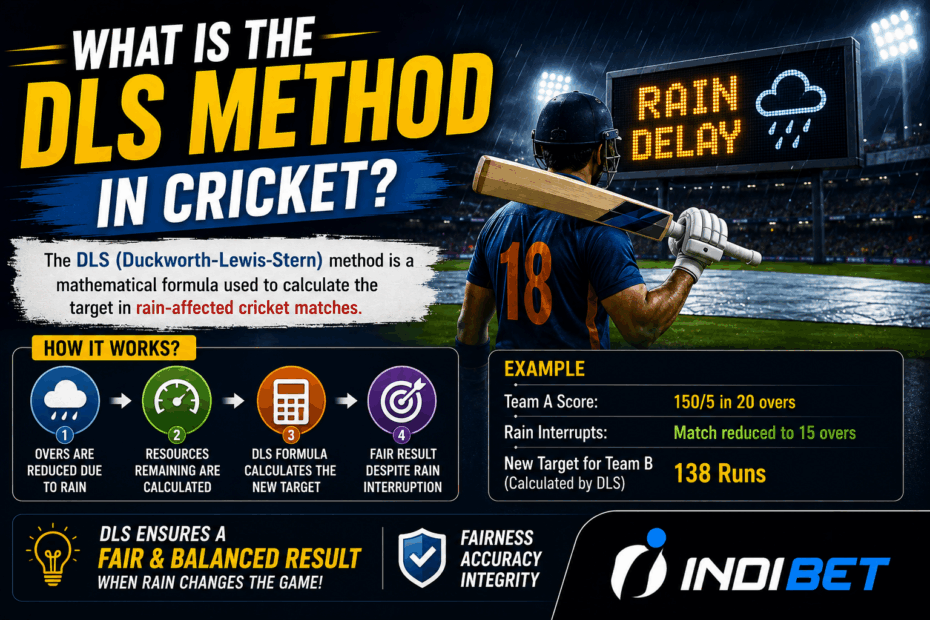
In a cricket match, usually a team wins when it makes more runs than the opposition team, or it is able to out all the players before the batting team achieves its goal. But what happens when the second batting team is unable to bat the allotted overs for various reasons? It happens generally due to heavy rains or delays when a batting team does not have the required overs to bat. In that situation, the Duckworth-Lewis-Stern (DLS) method is used to calculate the number of overs the second batting team will get.
The method is based on a fair decision with a perfect ratio of resources, runs, and wickets in hand, adjusted for the overs lost. This blog at Indibet completely explains why the DLS method is used in cricket, from when it started being used, why it is used, and examples of cricket matches in which DLS is used.
Understanding the DLS Method in Simple Terms
The Duckworth-Lewis-Stern (DLS) method was first used during an international cricket match between Zimbabwe and England on January 1, 1977. Later, the International Cricket Council (ICC) adopted it officially in 1999.
In simple terms, the DLS method is used to calculate the number of target runs to win by mathematical formulation for the team batting second in a limited-overs cricket match due to bad weather or other circumstances.
Why Is the DLS Method Used?
When the cricket match is unable to continue because of sudden bad weather, heavy rains, or other circumstances, the DLS method has to be used for the second batting team to calculate the target runs to win. It is necessary to use it because it ensures a fair result by adjusting the target based on the resources (overs and wickets) each team has available, rather than just comparing run rates, which can be unfair when play is shortened.
For upcoming cricket tournaments, complete the Indibet download and be a part of the most generous gaming platform.
When Does the DLS Method Come Into Effect?
Duckworth-Lewis-Stern (DLS) method was first used on January 1, 1977, in an ODI cricket match between Zimbabwe and England in Harare. Zimbabwe won by seven runs in that match. In 1999, the ICC officially introduced the DLS method in the rules as the standard method of calculating target scores in rain-shortened one-day matches.
Rain Interruptions
If it rains and the game has to stop and some overs are missed, the DLS method is used to make the target fair for the team that bats second. The team that bats second gets a target that is fair.
Delayed Starts
When a game starts late because of the weather or problems with the ground, and there are overs, the DLS method is used to change the target before the game even starts.
Reduced-Overs Matches
In some tournaments, games are planned to be shorter, like T20s or games with overs.
The DLS method makes sure the team that is chasing gets a target if the game is stopped again. This way, the team that is chasing has a chance to win the game.
How does the DLS Method Calculate the Target Score?
The DLS method calculates the target scores for the second batting team by comparing the scoring resources available to both teams. The team’s scoring resources are a combined percentage derived from two factors: overs remaining and wickets in hand.
The score is calculated according to two cases:
Case 1: Team 2 has fewer resources (R₂ < R₁)
This is the common situation: when the second team has less opportunity to score, they scale down proportionally,
Target = Team’s 1 score *(R2/R1) + 1
For example: When team 1 scores 300 by using 100% resources, that means R1 =100%. Now, rain interrupts before Team 2 starts playing, which reduces the innings to 30 overs. The DLS Calculator table dictates that 30 overs with 10 wickets left equals 75% resources (R₂ = 75%).
Par Score: 300 × (75 / 100) = 225
Target: 225+1=226 runs.
Case 2: Team 2 has more resources (R₂ > R₁)
It happens when Team 1’s inning is interrupted, but they don’t know whether it will be cut short. To penalize Team 1’s sudden disadvantage, Team 2’s target is increased using an average 50-over score constant known as G₅₀.
![Formula: Target = Team 1's Score + [ (R2 − R1) × G50/100 ] + 1. Indibet Betting and Casino](https://www.indibetofficial.in/wp-content/uploads/2026/07/image.png "image")
Here, the value G₅₀ changes periodically depending on International scoring trends.
Example of the DLS Method in a Cricket Match
Let’s have an example of the DLS method used in a cricket match:
IPL 2023 Final Match between CSK and GT
During the match, GT batted first using 100% resources, meaning batting for the full 20 overs, and set a target of 215 runs for CSK. After the innings, rain interrupted and delayed the match; as a result, CSK did not have full resources. So the DLS method was applied, and CSK had to make 71 runs in 15 overs.
DLS Method vs Duckworth-Lewis Method
The Duckworth-Lewis method was originally introduced in 1996 by statisticians Frank Duckworth and Tony Lewis. It finds a target based on two resources: overs remaining and wickets in hand. The DLS method is the updated version of the DL method; the only difference is accuracy. The DLS method gives more accurate calculations because of modern high-scoring games, especially T20s, by adjusting for aggressive batting styles and varying run rates.
Advantages and Limitations of the DLS Method
Advantages
- Fair: It depends on both overs left and wickets in hand, not just run rate.
- Flexible: Works in ODIs and T20s, even with multiple rain delays.
- Updated: Reflects modern high-scoring trends, especially in T20 cricket.
- Fast: Gives revised targets fast, reducing disputes.
Limitations
- Complex: Hard for fans to understand.
- Unrealistic targets: Sometimes sets very steep or unfair-looking scores.
- Overvalues wickets: Can inflate targets if the batting side hasn’t used wickets aggressively.
- Better in ODIs: Less accurate compared to 50 overs match in very short T20 games.
Famous Matches Decided by the DLS Method
- South Africa vs. Sri Lanka (2003 ODI World Cup)
- England vs. New Zealand (2013 Champions Trophy)
- Chennai Super Kings vs. Gujarat Titans (IPL 2023 Final)
- West Indies vs. England (1st ODI, 2009)
Understanding Modern Cricket Rules
Modern cricket rules are governed by the Marylebone Cricket Club (MCC) and the International Cricket Council (ICC). These modern cricket rules ensure the fairness and integrity of the game. This promotes competitive balance, player safety, and the spirit of sportsmanship in all formats of cricket tournaments. Sometimes, we fans are not able to understand how the target is set in delays; that’s why the DLS method is used to promote a fair result.
If you are a cricket fan, then download Indibet APK, because it would be your favourite platform to know more about cricket. And also, you can enjoy live cricket matches here on your mobile anytime. With today’s technology, Indibet login is one of the fastest-growing online gaming platforms with fast and secure transactions. Stay tuned!
FAQs
Who created the DLS method?
DLS method was created by statisticians Frank Duckworth and Tony Lewis in 1996.
Is the DLS method used in Test cricket?
No. It is not used in Test cricket; it is only used for short formats like T20 and ODI.
Why do fans find the DLS method confusing?
Because the formula used in DLS is not familiar to fans, and it uses complex calculations.
Can the DLS target change more than once during a match?
Yes. The DLS target can be changed more than one time due to bad weather or heavy rain.
Is the DLS method approved by the ICC?
Yes. It was approved by the ICC in 1999.
